
March 13, 2026
Why Property Taxes Vary Across Texas Counties
Texas proudly levies no state income tax, but that fiscal decision comes with a trade-off that every homeowner in the state understands: property taxes that rank among the highest in the United States. With an effective statewide rate of approximately 1.25% and a median annual tax bill above the national average, Texas places a meaningful burden on residential property owners with one that varies significantly across the state’s 254 counties. For many homeowners, filing a property tax protest is an important step to ensure they are not overpaid.
In 2026, the counties generating the largest tax bills are almost uniformly those experiencing the most explosive population growth: fast-expanding suburban rings around Dallas-Fort Worth, Houston, and Austin, where surging demand for homes has driven appraised values upward while simultaneously creating an urgent need for new schools, roads, and public infrastructure all funded primarily through property taxes. In these high-growth areas, a Texas tax protest can be an effective way to challenge rising assessments.
This article examines which Texas counties carry the heaviest tax burden in 2026, why appraisals are climbing so sharply in specific regions, and what homeowners can do to ensure their assessments are fair. For a full overview of recent statewide relief measures, see at TaxCutter.us.
How Texas County Property Taxes Are Calculated
Unlike most states, Texas has no centralised property tax system. Instead, your annual bill is determined by multiple overlapping local taxing entities your county, your school district, your city, and potentially several special-purpose districts such as municipal utility districts (MUDs) or hospital districts. Each of these entities sets its own rate independently, and those rates are combined to produce your total effective tax rate. This layered structure is why rates vary so substantially across and even within county lines.
The process begins each year on January 1, when your County Appraisal District (CAD) assesses the market value of your property. That figure, less any applicable exemptions, becomes your taxable value. Multiply that by your combined local rate, and the result is your bill. In high-growth counties where home values are climbing rapidly and public service demands are escalating in tandem; both sides of that equation tend to move unfavorably for homeowners year over year.
The Counties with the Highest Property Tax Bills in 2026
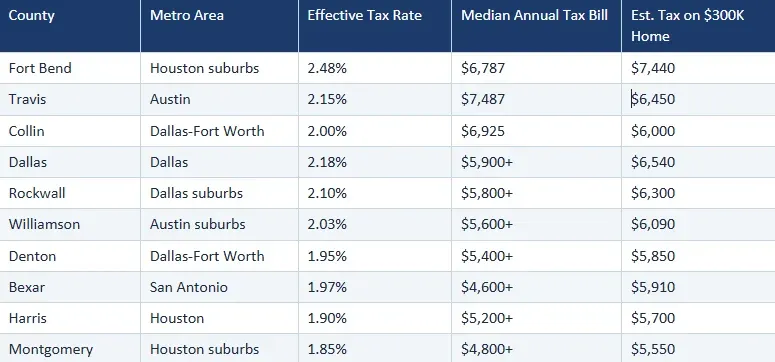
Based on data from 24/7 Wall St. (February 2026) and World Population Review (2026), the following counties consistently record the highest median annual property tax payments in Texas. Note that the figures below reflect median bills your actual liability depends on your specific appraised value, exemptions, and the combined rates of all applicable taxing entities.
County Profiles Why Each Area Carries Such a High Burden
Fort Bend County Highest Effective Rate in the State
Fort Bend County, encompassing Sugar Land, Cinco Ranch, and parts of southwestern Houston, holds the distinction of carrying the highest effective property tax rate among Texas’s major counties at approximately 2.48%. According to 24/7 Wall St., a homeowner with a $300,000 property faces a bill of roughly $7,440 per year. The county’s layered tax structure encompassing school districts, municipal utility districts, water authorities, and county services — reflects the enormous infrastructure investment required to sustain one of the nation’s fastest-growing suburban regions. Population has surpassed 958,000 and continues to climb.
Travis County Highest Median Bill in Texas
Home to Austin and the state capital, Travis County records the highest median annual property tax bill in Texas at approximately $7,487. The tech sector boom of the early 2020s marked by major corporate relocations from California and New York dramatically inflated home values across the county. While population growth in Travis itself has moderated slightly, the residual effect on appraised values continues to drive bills upward. A $300,000 home in Travis County generates an estimated $6,450 per year in property taxes.
Collin County Suburban Growth Meets Premium School Investment
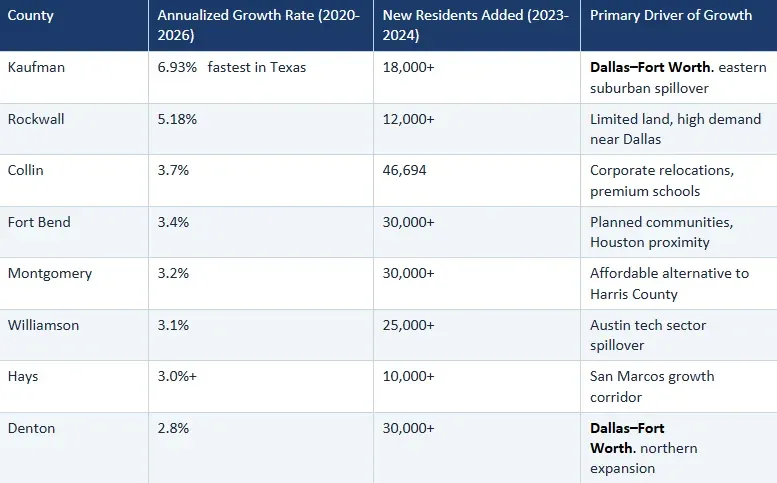
Collin County, home to Plano, Frisco, Allen, and McKinney, ranked fourth nationally for population growth in the most recent Census estimates, adding nearly 47,000 new residents in a single year according to KXAN (March 2025). That growth brings with it an expectation of premium public schools and expanding infrastructure both of which require substantial tax revenue. The county’s effective rate of approximately 2.00% on a median home value of $496,962 produces a median annual tax bill of around $6,925 one of the highest in the state.
Rockwall County The Smallest County with a Very Large Tax Bill
Rockwall is the smallest county in Texas by land area just 149 square miles yet its annualised population growth rate of 5.18% makes it one of the most densely pressured housing markets in the state. Rapid suburban development has compressed available land, pushed appraised values sharply higher, and created a cycle in which rising values and rising service costs reinforce one another. Its effective tax rate sits near 2.10%, producing estimated annual bills approaching $6,300 on a $300,000 home.
Fastest-Growing Counties with Rising Appraisals
Population growth is the single most reliable predictor of rising property tax burdens in Texas. As new residents arrive, demand for housing intensifies, driving up appraised values. Simultaneously, local governments must invest in schools, roads, utilities, and public safety to serve a larger population pushing tax rates upward. The combination creates a compounding effect that can significantly outpace income growth for long-established homeowners, making a property tax protest an important step in managing rising tax costs.
According to World Population Review (2026), Texas accounts for 15 of the top 50 fastest-growing counties in the United States. The counties below are not only growing rapidly in population they are the very same counties experiencing the most pronounced appraisal increases year over year:
What This Means for Homeowners
For residents of high-growth, high-tax counties, the financial reality of homeownership in 2026 is considerably more demanding than it was five years ago. Rising appraised values and elevated tax rates are compressing household budgets in several interconnected ways:
- Monthly mortgage costs have increased without any change in interest rate. Homeowners with escrow accounts have seen lenders automatically adjust monthly payments upward at annual reviews to account for higher tax bills. In a county like Fort Bend or Collin, a year-over-year tax increase of $800 translates to an immediate $67 rise in monthly outgoings.
- Long-established homeowners are bearing disproportionate costs. Texas’s 10% annual appraisal cap for homestead properties offers some protection but in counties where cumulative growth over several years has been significant, the cap has already been reached in consecutive assessment cycles, meaning many homeowners have seen maximum allowable increases year after year.
- First-time buyers face a steeper entry cost than the listing price suggests. Mortgage affordability calculators that rely on statewide average tax rates significantly underestimate the carrying cost of a home in Fort Bend, Collin, or Travis counties. A buyer qualifying for a $400,000 purchase in a lower-tax county may find the same home unaffordable in 2.4% county once taxes are factored into their debt-to-income ratio.
- Senior homeowners on fixed incomes are particularly vulnerable. Those who purchased their homes before the growth surge began now face reassessed values that bear little relationship to their original purchase price. Without the additional $60,000 senior exemption introduced under SB 23 in 2025, many would face bills that consume a significant share of fixed retirement income.
Appraisal Increases Why Your Value May Still Be Rising
Even homeowners who purchased their properties at peak prices during 2021 or 2022 are not necessarily protected from further appraisal increases in 2026. The reassessment lags the gap between actual market movements and formal county reassessments means that appraisal districts are still processing and applying value increases from the height of the boom, even as the market has since moderated in many areas. In such cases, a property tax protest can help ensure the assessed value reflects current market conditions.
In the fastest-growing counties, appraisals have consistently increased at or near the 10% homestead cap for multiple consecutive years. For a homeowner who bought a $350,000 home in 2019, that property may now carry an assessed value approaching $560,000 after six years of capped increases even if the actual market value today is lower. This disconnect between assessed value and genuine market value is precisely the situation in which a Texas tax protest can deliver the greatest benefit.
What Homeowners in High-Tax Counties Should Do
Residing in one of Texas’s highest-tax counties does not mean accepting an inflated bill without scrutiny. There are concrete, proven steps that can meaningfully reduce your annual liability:
Verify Your Homestead Exemption Is Active
The $140,000 homestead exemption enacted under SB 4 in 2025 is the single most impactful relief measure available to Texas homeowners but it requires an active application on file with your County Appraisal District. If you have never applied, or if you moved recently, submit Form 50-114 via the Texas Comptroller’s website without delay. There is no cost to apply, and the saving is immediate.
Examine Your Notice of Appraised Value Carefully
Every spring, your county appraisal district issues a Notice of Appraised Value the foundation of your entire tax bill. Cross-reference that figure against recent comparable sales in your immediate neighborhood. Platforms such as the County appraisal district own public portal and the Texas Comptroller’s property search tool allow you to review what similar properties are assessed at. If your value appears materially higher than either recent sales or comparable assessments, you have substantive grounds for a protest.
File a Protest Before May 15
Texas law gives every homeowner the right to formally contest their appraisal. The deadline is May 15 each year, or 30 days from the date your notice is issued whichever falls later. Filing a protest is free of charge and carries no risk of an upward adjustment to your bill.
Claim Senior and Additional Exemptions If Eligible
Homeowners aged 65 or older, those with qualifying disabilities, and qualifying veterans are entitled to significant additional exemptions that further reduce their taxable value.