

March 16, 2026
How Appraisal Districts Shape Texas Property Taxes
Most Texas homeowners track the headline numbers: the homestead exemption amount, the relief package the Legislature passed. What gets far less attention is the institution that controls the figure your entire tax bill is built on your County Appraisal District. Every year, the policies adopted inside that office determine how your home is valued, how aggressively that value rises, and how fairly the protest process operates. In 2025 and 2026, those policies became the front line of the property tax debate in Texas.
A landmark dispute in Tarrant County triggered statewide legislation. New governance rules changed the structure of every large appraisal district board in Texas. A series of Texas legislative reforms strengthened homeowners’ rights inside the protest hearing room. And Governor Abbott has made appraisal policy the centerpiece of his 2026 campaign. For any homeowner who wants to understand and manage their tax liability, understanding how these districts operate is now essential. For the full picture on related exemptions and relief, see at TaxCutter.us.
What a County Appraisal District Does
Texas has 254 counties, each with its own County Appraisal District an independent governmental body whose sole function is to estimate the market value of every taxable property in the county as of January 1 each year. That figure, your appraised value, is the foundation of your entire tax bill. Every taxing entity that appears on your statement—school district, county, city, and special purpose districts multiplies its own rate against your appraised value to calculate its share of what you owe. When valuations appear inaccurate, filing a property tax protest becomes an important step to ensure fairness.
Appraisal districts do not set tax rates and do not collect taxes; they only produce values. But because every dollar added to your appraised value directly increases your bill across all those entities simultaneously, the district’s annual decisions carry an outsized financial consequence. A district that appraises aggressively costs homeowners money every year, while one with inconsistent methodology produces unequal results across similar properties on the same street situations where a Texas tax protest can help correct discrepancies and reduce the financial impact.
Districts use a process called Computer Assisted Mass Appraisal to estimate values across thousands of properties at once, using comparable sales data, property characteristics, and market trend models. As explained by the Fort Bend Central Appraisal District, the model analyses attributes including construction quality, year built, size, condition, and location features for every property in its database. The limitation is that no statistical model captures every individual property accurately which is precisely why the right to protest exists, and why homeowners who bring specific, credible evidence to a hearing win reduction consistently.
New Governance Rules: Who Controls Your Appraisal District
One of the most structural changes to flow from recent Texas legislation is the reform of how appraisal districts are governed. Under the new rules, appraisal districts in counties with populations above 75,000 now operate under a nine-member board of directors up from the previous five. The expanded board consists of three popularly elected members, five members appointed by participating taxing units, and the county tax assessor-collector serving as an ex officio voting member, as confirmed by the Fort Bend Central Appraisal District’s 2025 governance summary.
The board appoints the Chief Appraiser, approves the annual reappraisal plan, and sets the district’s operating budget. Under the new structure, the board is also now directly responsible for appointing individual Appraisal Review Board members the panellists who hear and decide property tax protests. This change matters directly to homeowners: who sits on the ARB, and how they are selected, influences the fairness of every protest hearing in the county. For a full directory of every appraisal district in Texas, visit the Texas Comptroller’s appraisal district directory.
The Tarrant County Controversy: Annual Appraisals and Policy Changes
In 2024, developments at the Tarrant Appraisal District drew statewide attention and sparked debate about appraisal practices in Texas. Newly elected board members discussed policy changes aimed at limiting rapid increases in residential property values, including proposals to adjust appraisal schedules and place tighter controls on large valuation increases compared with prior years. As reported by regional news outlets in early 2025, these discussions quickly became part of a broader statewide conversation about how appraisal districts should balance taxpayer protections with accurate and consistent property valuations an issue that often leads homeowners to seek property tax reduction when values appear excessive.
The proposals prompted immediate attention from state officials and lawmakers, who raised concerns about maintaining consistent appraisal standards across Texas counties. In response, lawmakers introduced legislation in 2025 aimed at reinforcing uniform appraisal practices across the state.
By 2026, annual appraisal practices remain the standard across Texas counties, helping maintain consistent property valuations used by local governments. In this environment, many homeowners choose to protest property tax assessments to ensure fairness and accuracy
How the 2025 Legislative Reforms Changed District Accountability
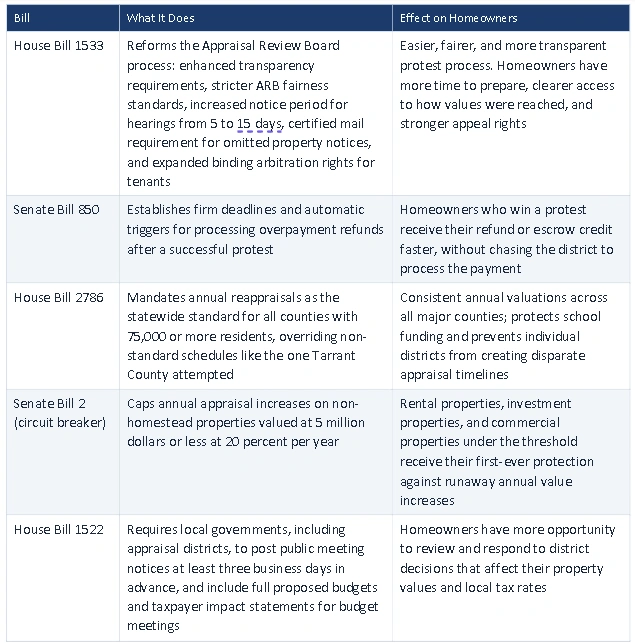
The 89th Texas Legislature delivered a package of reforms that changed how appraisal districts operate and how homeowners can challenge them. The key measures are summarised below. Sources: Texas Comptroller, Property Tax Today (January 2026) and Texas Policy Research, HB 1533 analysis.
The Comptroller’s Oversight: Keeping Districts Honest
To ensure consistent standards across all 254 counties, the Texas Comptroller’s Property Tax Assistance Division runs two ongoing accountability programs that directly affect how each appraisal district operates.
The Methods and Assistance Program (MAP) conducts regular reviews of each district across four areas: governance, taxpayer assistance, operations, and compliance with accepted appraisal methodology. The 2026–2027 review cycle began in January 2026, with reviewers working through August to develop recommendations for districts under review. Final reports from the 2025 cycle were released in January 2026 and are publicly available on theTexas Comptroller’s MAP page. Districts that receive poor scores are subject to corrective measures.
The Appraisal Cap Debate: What Is on the Table for 2027
The current 10 percent annual homestead appraisal cap which limits how much your assessed value can rise in any single year is set to expire in 2026 unless the 2027 Legislature acts to renew or replace it. Governor Abbott has proposed reducing it to 3 percent and extending it to all property types, not just homesteads. As analysed by The Texas Tribune (December 2025), tax policy experts across the political spectrum warn the proposal risks replicating the long-term inequities of California’s Proposition 13: higher housing costs, reduced market mobility, and tax benefits accumulating disproportionately among wealthier long-term owners.
Abbott has also proposed moving all property appraisals to a five-year cycle, down from the current annual model. A detailed critique by Texas Policy Research (December 2025) notes that while a longer cycle offers short-term predictability, it would cause sharper correction spikes when the next reappraisal occurs, as values reset to reflect years of accumulated market growth. Lt. Governor Dan Patrick has put forward a separate, narrower plan focused on expanding exemptions and lowering the age at which the senior tax freeze activates from 65 to 55