

1. Client
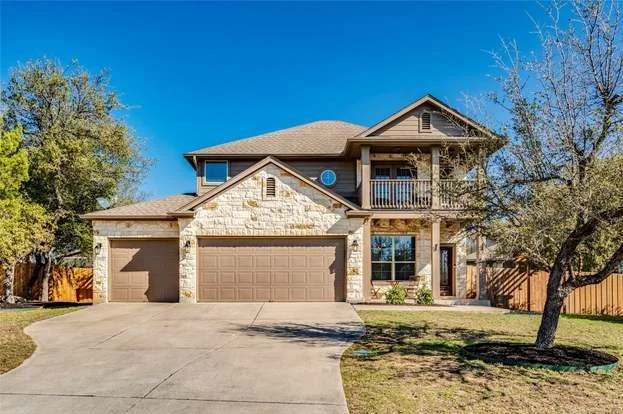
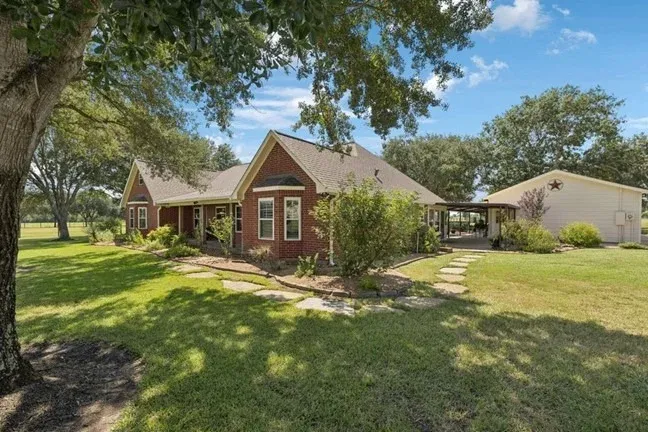
This case was filed on behalf of the owner of a residential property at 506 Bowcross, Austin, TX 78738, located in Travis County, Texas. The protest was filed as part of the Travis County property tax protest process for the 2025 tax year.
2. Executive Summary
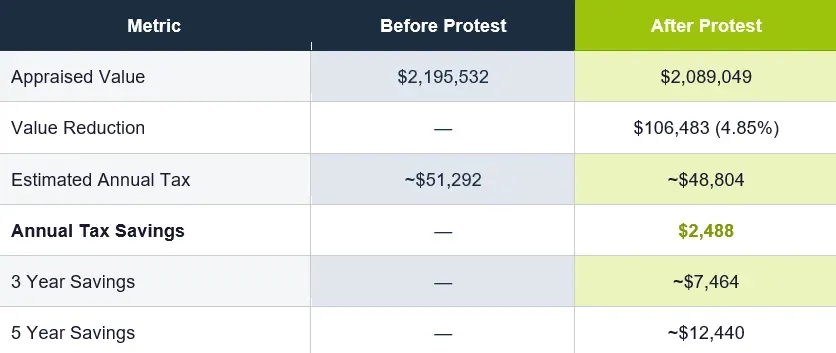
For the 2025 tax year, the Travis Central Appraisal District assessed the residential property at $2,195,532. Our independent market analysis identified a $106,483 overvaluation relative to its fair market value.
to recent comparable sales in the Austin area. Following a formal protest before the Travis County Appraisal Review Board, the assessed value was reduced to $2,089,049, a 4.85% reduction that delivers $2,488 in confirmed annual Travis County property tax savings and a projected $12,440 in savings over five years.
3. The Challenge
Travis County is one of the fastest-growing counties in Texas, driven by the continued expansion of the Austin metropolitan area. The Travis Central Appraisal District operates under constant pressure to revise assessed values in step with market appreciation, a process that frequently overshoots the mark for individual properties, particularly at the higher end of the residential market where the property is positioned. At the $2M+ price point, genuine comparable sales are limited, and mass appraisal models are most prone to producing figures that diverge from actual open market value.
The core challenges in this case were:
• Travis Central Appraisal District assessed value exceeded defensible fair market value by $106,483, confirmed through a comparable sales analysis.
• Higher-value residential properties in Travis County face a structurally limited pool of true comparables, increasing the margin for appraisal error at this price tier.
• At an effective tax rate of approximately 2.3362%, the inflated assessment was generating an estimated annual tax liability of approximately $51,292, approximately $2,488 more than the property’s fair value warranted.
• The Texas property tax protest process requires timely filings and properly structured evidence standards that are difficult to meet without professional assistance.
4. Our Solution
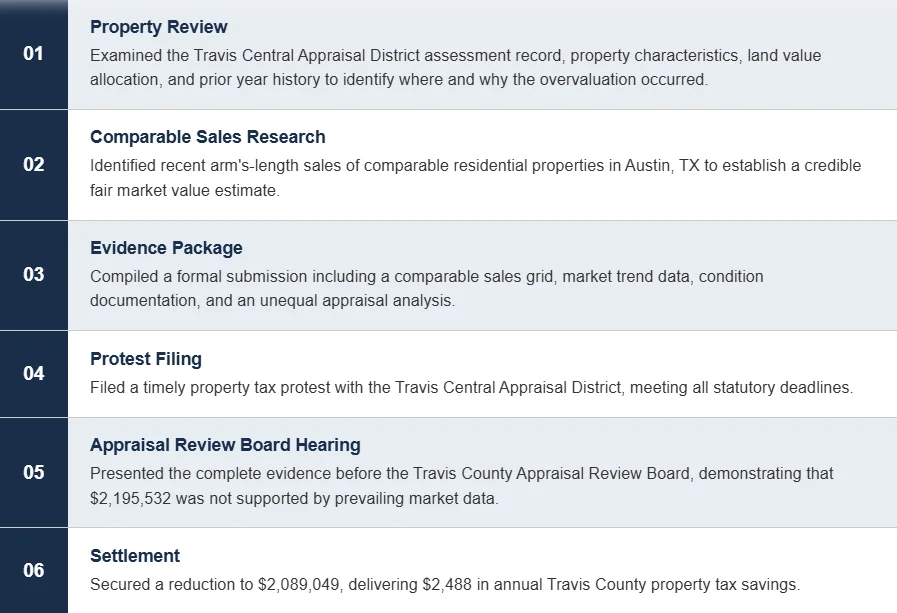
We executed a structured, evidence-based protest on the owner’ s behalf, grounded in the provisions of the Texas Property Tax Code, Chapter 41. The process proceeded across six steps:
5. Results and Outcome

Five Year Cumulative Savings Projection
Each bar below represents the total savings accumulated by that year.

6. Conclusion
This case shows the financial impact of professional property tax representation in Travis County. Through detailed market research, strong evidence preparation, and representation during the property tax protest process, we secured a $106,483 reduction in the assessed property value. This resulted in $2,488 in annual property tax savings and more than $12,000 in projected savings over five years. Over-assessment is a common issue in Travis County, particularly for higher-value properties where comparable market data may be limited. With proper review and representation, these overvaluations can often be corrected.